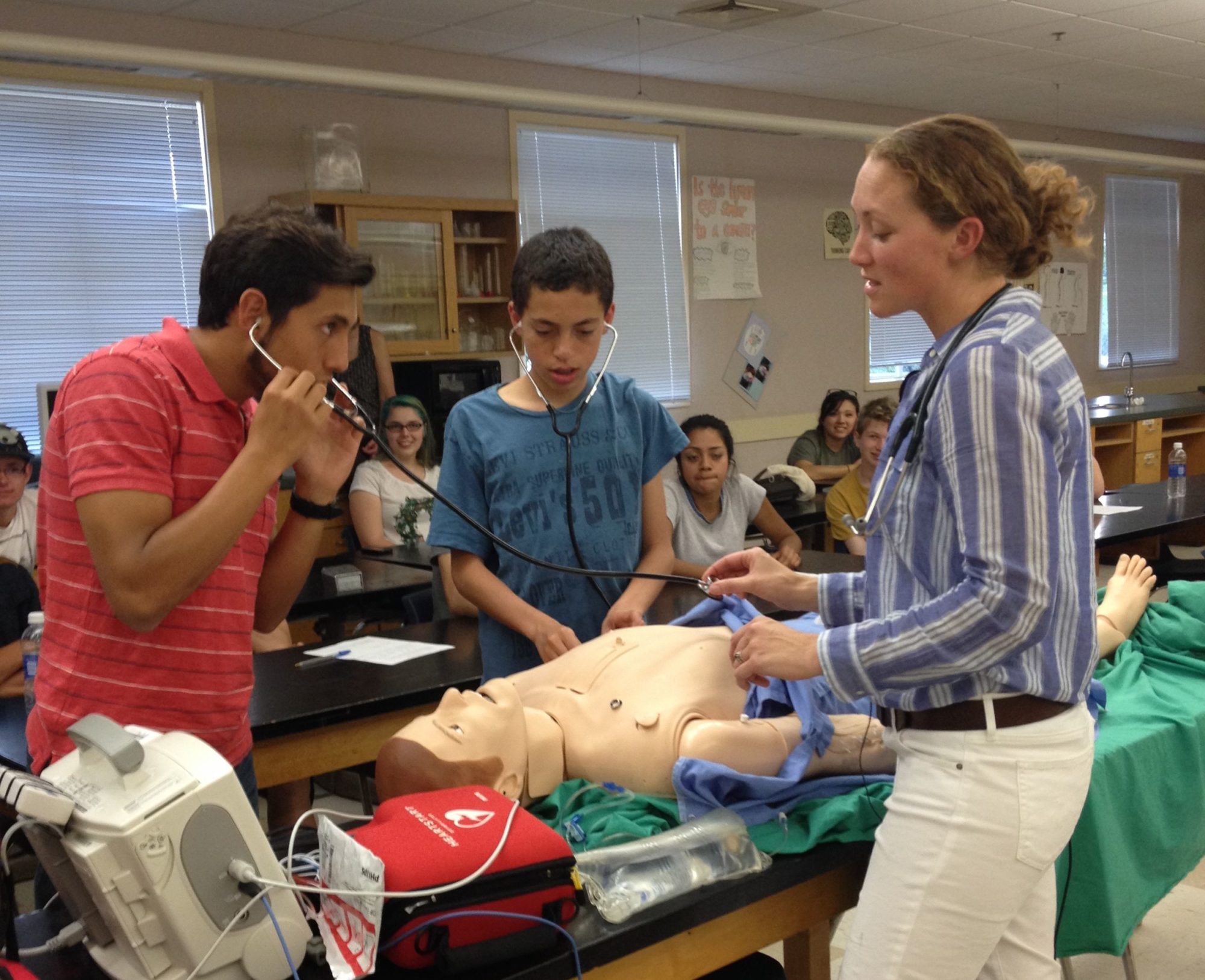
Let’s welcome back Vania Coelho, Ph.D. of Dominican University 

Photo by Vania Coelho

Homeless Nemo: What Does the Future Hold for Coral Reef Communities?

Wednesday, October 5, 2011
Terra Linda HS, San Rafael, CA – Room 207
7:30 – 8:30 pm

Coral reefs are undoubtedly among the most threatened ecosystems in the world. Studies predict that without increased conservation and restoration efforts a complete collapse is only a few decades away. This talk will focus on the current status of coral reefs around the world, including threats to them and the consequences of those threats. (4/30/08, 9/29/10, October 5, 2011) Get the flyer here.
 
Dr. Coelho holds degrees in Biology, Ecology and Zoology and she completed doctoral research while working as a visiting scientist at the National Museum of Natural History, Smithsonian Institution. After completing her doctorate she held research scientist positions at Columbia University. Dr. Coelho’s research focuses on the ecology and evolutionary biology of marine invertebrates including benthic community ecology, population biology, behavior, systematics of crustaceans, and coral reef ecology. She is currently Associate Professor of Biology at Dominican University.

Sea Cucumbers Invade TLHS!

Wed. January 26, 2011

Life in the Slow Lane – Peristaltic Locomotion in Sea Cucumbers” How exactly do soft-bodied animals get around? This talk combines results from projects investigating locomotion in four species of sea cucumbers (Echinoderms). Professor Spain will talk about peristaltic locomotion being used to crawl and burrow into sand. She will also give an overview of results on the kinematics analysis of crawling across sand. These include variables like stride distance, stride length, and crawling velocity. Crawl on over and check it out! Download the flyer. (January 26, 2011)  

Dr. Spain is Assistant Professor of Biology at Dominican University, San Rafael. She earned her B.S. in Biology Education from North Carolina Agricultural and Technical State University and her Ph.D. in Biology from the University of North Carolina at Chapel Hill. Currently, her research focuses on the functional morphology and locomotion of invertebrates

Physics for Future Presidents

with Professor Richard Muller of UC Berkeley
Wednesday, November 10, 2010 7:30 – 8:30 pm
Terra Linda High School, San Rafael, Room 207

Physics for future Presidents?  Yes, that is a serious title. Energy, global warming, terrorism and counter-terrorism, nukes, cancer, internet, satellites, remote sensing, ICBMs and ABMs, DVDs and HDTVs — economic and political issues increasingly have a strong high tech content. Misjudge the science, make a wrong decision. Yet many of our leaders never studied physics, and do not understand science and technology.  I will .. give you a quick course in what you need to know about the physics of terrorism, nukes, alternative energy, and global warming.
Richard Muller is Professor of Physics at the University of California, Berkeley and Faculty Senior Scientist at Lawrence Berkeley National Laboratory.

Homeless Nemo: What Does the Future Hold for Coral Reef Communities?

Homeless Nemo: What Does the Future Hold for Coral Reef Communities?
with Vania Coelho, Ph.D. of Dominican University, San Rafael, CA

Coral reefs are undoubtedly among the most threatened ecosystems in the world. Studies predict that without increased conservation and restoration efforts a complete collapse is only a few decades away. This talk will focus on the current status of coral reefs around the world, including threats to them and the consequences of those threats. (April 30, 2008; September 29, 2010) Get the flyer here.
 
Dr. Coelho holds degrees in Biology, Ecology and Zoology and she completed doctoral research while working as a visiting scientist at the National Museum of Natural History, Smithsonian Institution. After completing her doctorate she held research scientist positions at Columbia University. Dr. Coelho’s research focuses on the ecology and evolutionary biology of marine invertebrates including benthic community ecology, population biology, behavior, systematics of crustaceans, and coral reef ecology. She is currently Associate Professor of Biology at Dominican University.
 

Ants: The Invisible Majority

Brian Fisher, Ph.D.

Marin Science Seminar Presentation: “Ants: The Invisible Majority(September 22, 2010) Download the flyer here.
Dr. Fisher is modern day explorer who treks through the last remote rainforests, deserts and plains of Madagascar in search of ants.  His research highlights insects as a useful tool to discover and preserve all plants and animals on this unique island.   Along the way he has discovered over 1000 new species including the jumping ants and Dracula ants. He has published over 75 peer reviewed articles in scholarly journals including the recently published “Ants of North America” with Stefan Cover. He has appeared in a number of BBC, Discover Channel, and National Geographic films and has been profiled in Newsweek and Discover magazine. When not working in the field, Dr. Fisher lives with the banana slugs in a treehouse in Marin County. 
Dr. Fisher is currently Associate Curator of Entomology at the California Academy of Sciences and adjunct professor of biology at both the University of California at Berkeley and San Francisco State University.

Cartoon Physics – How Scientists and Artists Make Pixar Films

with Rod Bogart of Pixar
Wed. Sept. 15, 2010, 7:30 pm, TLHS, San Rafael, CA

Pixar films are known for their characters and stories, but how is the film actually made? This talk will describe the various applications of math and science behind the art, from animation and
simulation, through shading and lighting, to mastering for the
audience.
 

Rod Bogart joined Pixar in 2005 after spending ten years as a software engineer at Industrial Light & Magic. He has a M.S. from the University of Utah, where he specialized in computer graphics. At Pixar, Mr. Bogart is in charge of color science at the studio, overseeing the technology for creating the final distributed masters of the movie.

Nanoscience Now (Let’s move atoms one by one and watch them with powerful microscopes!)

with Miquel Salmeron, Ph.D. of Lawrence Berkeley Labs
Wednesday, September 8th, 2010
7:30 – 8:30 pm
Terra Linda High School, Room 207

Prof. M. Salmeron is the Director of the Materials Science Division at the Lawrence Berkeley National Laboratory and Adjunct Professor at UC Berkeley Materials Science and Engineering Department. He is the Scientific Director of the Imaging and Manipulation Facility of the Molecular Foundry, the Department of Energy Nanoscience Institute in Berkeley.  He received his B.A. in Physics from the University of Barcelona, and his Ph.D. from the University Autonoma of Madrid, Spain, in 1975.  In 1984 he moved to the Lawrence Berkeley National Laboratory as a Divisional Fellow, becoming a Senior Scientist in 1996.

His research focuses on atomic scale structure and properties of surfaces and nanomaterials for applications in electronics, catalysis, tribology and environmental science.  He was elected Fellow of the American Physical Society in 1996 and of the American Vacuum Society in 2003.  He received the Outstanding Research Award in 1996 and the Outstanding Scientific Accomplishment Award in Materials Chemistry in 1995 from the U.S. Department of Energy.  In 2004 he received the Klaus Halbach Award for the development of innovative instrumentation at the Advanced Light Source.  In 2008 he received the Medard Welch Award of the American Vacuum Society and the Langmuir Lectureship Award of the American Chemical Society.

Prof. Salmeron is the President of the Scientific Advisory Board of the “Institut Catala de Nanotecnologia” inBarcelona, Spain.  He has published 390 Journal articles and book chapters.

I can hardly believe this. This woman is making her own transistors with silicon wafers and a few chemicals, some of which are from the hardware store.

She made a MOSFET, incredibly.

Here is it

The Decision Tree with Wired editor Thomas Goetz

Marin Science Seminar visited Kishore Hari’s Down to a Science cafe in San Francisco last week and participated in a fun game-show style presentation on using technology to make and track personal medical decisions.  One of the kids got to play the part of a basketball player with a genetic heart condition which might preclude him from continuing his lucrative career.  Wisely, he chose not to continue playing so he wouldn’t suddenly drop dead.  Wired editor Thomas Goetz  ran the show while explaining how new technologies can help us to make better medical and personal health choices.  He then entertained a lively discussion on health care, bioethics and physician vs. patient access to expertise.  Here is a pic of some of the MSS young people with Kishore and Thomas, and a copy of Thomas’s book The Decision Tree, which he very generously signed and gave to each of the game-show participants.  A edutaining time was had by all!