The Future of Medical Education: Death-Defying Robots

by Claire Watry, Terra Linda HS

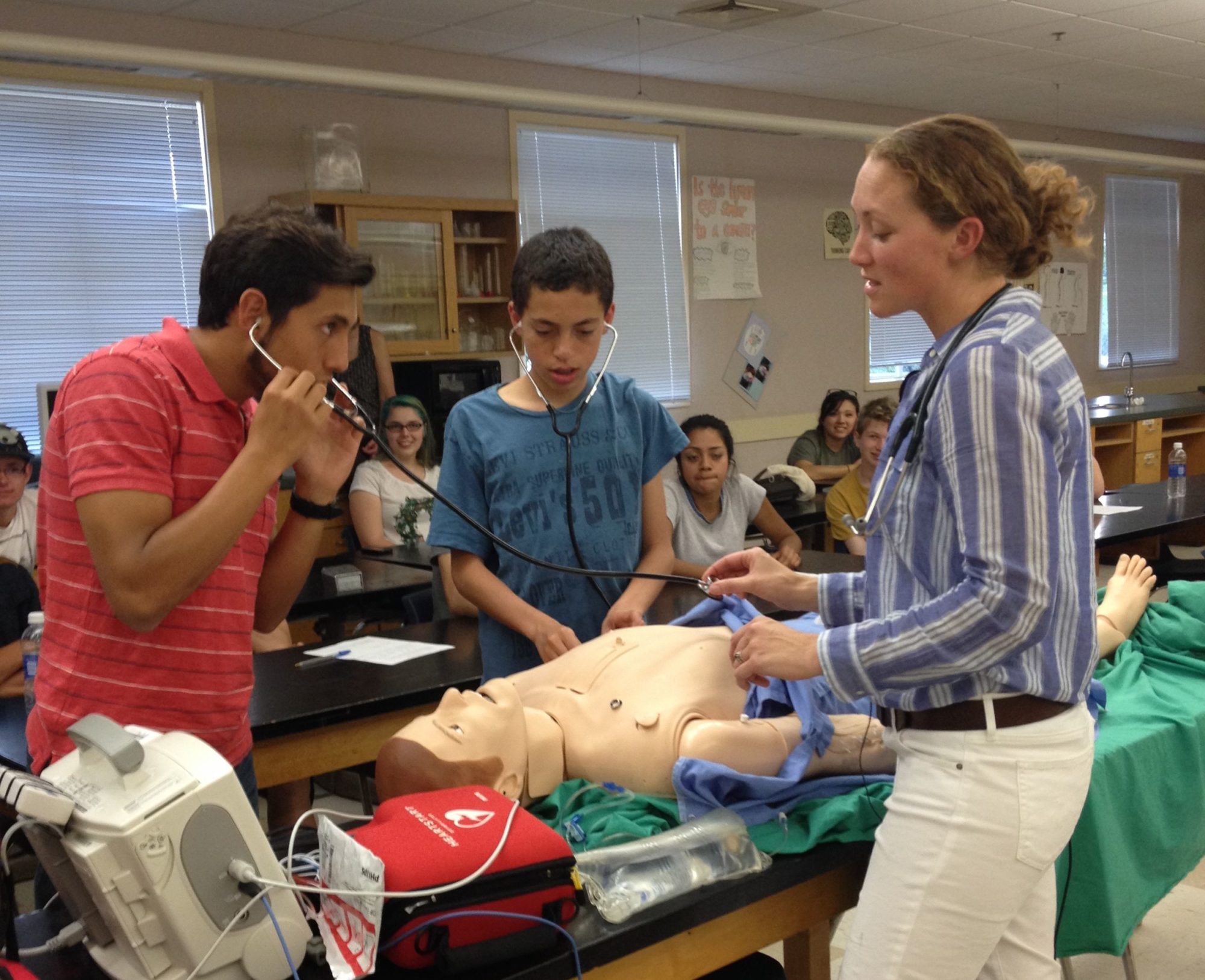
This week the Marin Science Seminar introduces a unique presentation on medical education with Rich Fidler PhD MBA and Abi FitzGerald MSN RN of the VA Medical Center and their special guests – robots! These humanlike robots are utilized by medical practitioners at the Simulation Center at the VMCA in San Francisco to learn how to perform a variety of procedures and respond appropriately to different emergency scenarios. 

Rich Fidler is the Director of the Healthcare Simulation which places him in charge of all of the simulation research, education, training, and process evaluations that take place in the entire hospital, including emergency, critical care, surgery, and disaster preparedness. Fidler is also the Co-Director of the Fellowship Program in Advanced Clinical Simulation. Fidler explains this role in the following quote; “I am responsible for ensuring that our advanced fellows are receiving challenging experiences, quality didactic education in statistics, research design, thoughtful data analysis. I also ensure that they will be able to go out to conduct clinical simulations independently.” In order to obtain these job titles, Fidler has collected numerous degrees and gone through extensive medical training. 


Read the interview with Rich Fidler below and be sure to attend this weeks’s Marin Science Seminar. 

What degrees and training do you have, and how do they relate to each other?


PhD in Physiological Nursing from UCSF–allows me to apply knowledge and principles of physiology to understanding biomedical engineering solutions to clinical problems.

MS in Human Factors Engineering–allows me to understand human-technology interfacing, and allows me to more completely understand the reasons that people have problems operating medical equipment. 
Anesthesia Training–allows me the skill set for airway and physiologic patient monitoring and surgical perspective for a well-rounded clinical practice
Critical Care Training–allows me the experience to provide care for the sickest of hospitalized patients, applying physiology, chemistry, and pharmacology to improving patient conditions.
Primary Care Training–allows me the perspective to understand how diseases evolve over long periods of time, and also allows me to see how patients choose to participate in their healthcare
MBA–having a master’s of business administration allows me the knowledge to understand people operating in a system, particularly with skills related to managing people. Frequently, it is important for me to elicit a particular behavior from our staff, but this needs to be done respectfully so that the employees WANT to do a good job.

How did you become interested in the medical field? 

I developed a special interest in healthcare when my grandfather became ill with heart problems while I was young. As early as 8 years old, I would go to spend every evening with my grandfather to try to make him feel better by pushing the fluid out of his legs. From there, I got more interested in why his heart was failing and how I could make it better. I got more interested in cardiac resuscitation after my grandfather had a sudden cardiac death event and we saved him. Then my own father had a series of 3 cardiac arrests which he survived from high quality CPR and early defibrillation, but he eventually died with the fourth cardiac arrest. 


How did you become involved in the Simulation Center?


I have always liked teaching, and I think that learning with your hands is better than someone talking you to death. When I told my father about what I did with simulation, he said, ” You can’t make a living playing with dolls.” I guess I showed that you should do what you like to do, even if your parents don’t think it’s worthwhile. You have to make yourself, not your parents, happy with your career. The harder stunt is to figure out how to make lots of money doing what you love!


Example of a Simulation Center
What projects have you worked or are you currently working on in the Simulation Center?
Defibrillators.
Resuscitation.
Heart monitors.
Disaster evacuation from the hospital in the middle of surgery.
Should we unwire a jaw wired closed or do a cricothyrotomy to get oxygen to the patient?
What is the best way to open a chest for bleeding in the immediate post-open heart period?


What is the most rewarding part of your job?
Seeing people that did not know how to do something not only learn how to do it, but also gain a certain amount of confidence and mastery doing the new task. 


What advice do you have for young people aspiring to have a career in the medical field? 

Do it! My grandfather said that I should either be an obstetrician or an undertaker, that way you can get people either coming or going! If you aspire to go into the healthcare field, explore your options. Becoming a physician or nurse is not your only option to make a meaningful contribution to healthcare. Medical research, especially with the human genome, is really exciting. If I were growing up now, I would probably be fascinated with that. Also, the roles of pharmacists and therapists are frequently overlooked as vital members of the healthcare team. The money should NOT be a factor in your decision. No job is worth getting up every day if you hate going. I love going to my job every single day.


Check out this very exciting presentation “Death-Defying Robots in Medical Education” with Rich Fidler PhD MBA and Abi FitzGerald MSN RN of the VA Medical Center on Wednesday, May 14 7:30 – 8:30 pm, Terra Linda High School, San Rafael, Room 207. 

Read an excellent article about Rich Fidler here 

~Claire Watry

Links:
http://scienceofcaring.ucsf.edu/acute-and-transitional-care/improving-cardiac-care-science-human-use
http://www.ucsf.edu/news/2011/01/8397/new-teaching-and-learning-center-transform-health-education-ucsf
https://www.youtube.com/watch?v=cZNa0vmdgSI


Spreading Smiles Around the World

by Gillian Parker, Tamalpais HS
Dr. Maureen Valley

Maureen Valley is an orthodontic care provider at Valley Orthodontics in San Rafael, and she is Associate Professor and Director of the Postgraduate Orthodontic Clinic at the University of the Pacific School of Dentistry in San Francisco. You can read more about her career in orthodontics in the U.S. here.

She received her Doctorate in Dental Medicine (D.M.D.) and her Masters of Public Health from Harvard University, and her Bachelor of Arts degree in Biology at University of California, Santa Barbara. In the Summer of 2013, Dr. Valley traveled to Kenya with her husband to take part in a Rotary International project to improve oral health in Kenya. Click here for more information about the Kenya Smiles Project.

She primarily worked with a tribe called the Maasai. One member of the Maasai tribe, Mr. Samson Saigilu, a public health official in Kenya, worked alongside Dr. Valley on the Kenya Smiles Project, and he will be presenting with Dr. Valley at the upcoming Marin Science Seminar.

Samson Saigilu
Read the following interview with Maureen Valley to find out more about her work in Kenya.

Why did you decide to go to Kenya?
In 2012, I went to Kenya for the first time with my family for safari.  I fell in love with the country and the Maasai people.  I wanted to return, but this time to help the people.

What exactly were you your activities in Kenya?
The most important impact we made was education.  We introduced the people to tooth brushing, as most all of them have never done this in their whole life.  Also, education on nutrition as modern foods have now entered their communities.  This in combination with no tooth brushing or dental care has been disastrous.

What are your favorite/least favorite parts of your job/working in Kenya?
My most favorite parts of working in Kenya: working with the beautiful Maasai people.  My least favorite parts of working in Kenya: being labeled by the color of my skin.  As it symbolized certain things.  It was a strange experience for me.

What would you have to say to aspiring dentists and orthodontists?
Some advice for aspiring dentists and orthodontist:  It is a great profession if you have the passion and willingness to help others, not only in your community, but also anywhere in the world.  Here is a quote from Samson, “The passion for a community free from preventable diseases can always drive someone anywhere in the world.”

To learn more, go to the Marin Science Seminar, “Spreading Smiles Worldwide: Oral Healthcare Outreach and Research among the Maasai in Kenya” and hear Dr. Valley and Mr. Saigilu talk about their work in Kenya on Wednesday, April 23, 7:30-8:30 pm at Terra Linda High School, San Rafael, Room 207.


Public Health Challenges in Kenya

by Claire Watry, Terra Linda HS

As inhabitants of a developing nation, the people of Kenya face many obstacles in receiving basic healthcare. According to the Global Health Department at the Massachusetts Institute of Technology, there are five main issues in delivering adequate healthcare in Kenya: infrastructure, lack of funding, access to care in rural areas, price and affordability of medicines, and politics. Statistics from the World Health Organization in 2006 showed that the top five causes of death in Kenya were HIV/AIDS followed by respiratory infections, diarrheal disease, tuberculosis, and malaria. While healthcare in Kenya has been steadily improving, there are still many challenges to overcome especially concerning healthcare access in rural areas. The video below shows the hardships people in rural areas of Kenya face in obtaining healthcare.

Affordable Health Care Still a Dream for Rural Kenya

Access to clean water is one of the biggest health issues in Kenya, especially in rural areas. In rural areas only 54% of people used improved water sources compared to the 83% of people in urban areas who used improved water sources in the year 2011 (UNICEF). In rural areas, the water sources are often shared by livestock and contaminated by feces from the livestock, making the water unsafe to drink. 

A short-term solution to unsafe drinking water is the LifeStraw water filter. The LifeStraw water filter allows an individual to drink directly from a water source or bottle just as a person would normally drink through a straw. The waterborne bacteria and other contaminants found in the water can cause severe diarrhea, which is the third leading cause of death in Kenya. LifeStraw prevents these deaths by effectively removing 99.99999% of bacteria and 99.9% of protozoa from the water. 

Kenya is reliant on outside donors and organizations in order to receive adequate and affordable health services. The LifeStraw Carbon for Water campaign put on by ClimateCare is one of these many organizations. This project distributed 877,505 LifeStraw Family filters to households in Kenya’s Western Province which supply safe drinking water directly to 4.5 million people. The video here explains the project and its success in depth. 

Another organization called BedNets for Children distributes bed nets to prevent children and their families from contracting malaria from mosquitos. A statistic from the organization’s website states that a child in Africa dies every 60 seconds from malaria. Bed nets have been shown to be very effective in preventing malaria especially for young children under two years of age. The World Health Organization has reported a 33% reduction in malaria deaths in sub-Saharan Africa since 2000. 


The First Lady of Kenya Margaret Kenyatta recently announced a “Beyond Zero Campaign” to improve maternal and child health outcomes by combating HIV/AIDS. According to the website, “fifteen women die every day due to pregnancy related complications in Kenya and 20% of all deaths among mothers in the country are AIDS-related.” The campaign has five key elements: “(i) Accelerating HIV programs, (ii) Influencing investment in high impact activities to promote maternal and child health and HIV control, (iii) Mobilizing men as clients, partners and agents of change, (iv) Involving communities to address barriers to accessing HIV, maternal and child health services and (v) Providing leadership, accountability and recognition to accelerate the attainment of HIV, maternal and child health targets.” The goal of the project is to eliminate preventable deaths in children and mothers. 


This week’s MSS speaker Maureen Valley DMD MPH participates in two organizations that teach the importance of oral hygiene in Kenya, Kenya Smiles and the Loitikotok Oral Health and Nutrition Project. Through these organizations, Valley distributes toothbrushes and toothpaste, collects research about dental hygiene, and educates children and other community members about oral health. 
The objectives of Kenya Smiles
Loitikotok Oral Health and Nutrition Project


To learn about oral healthcare outreach in Kenya, attend the Marin Science Seminar presentation “Spreading Smiles Worldwide: Oral Healthcare Outreach and Research among the Maasai in Kenya” with Maureen Valley DMD MPH and Samson Saigilu on Wednesday April 23, 2014, 7:30 – 8:30 pm, Terra Linda High School, San Rafael, Room 207. 


Information Sources:
World Health Organization http://www.who.int/countries/ken/en/

ClimateCare http://climatecare.org/our-projects/lifestraw-carbon-for-water/
UnAIDS http://www.unaids.org/en/resources/presscentre/featurestories/2014/january/20140130beyondzerocampaign/
Kenya Smiles http://www.kenyasmiles.org/
Valley Orthodontics http://www.valleyorthodontics.net/#!about4/csaq

Image Sources:
http://www.blackmountainsurvival.com/catalog/lifestraw/

Video Source:
https://www.youtube.com/watch?v=_ansnQOfz2Y

~ Claire Watry


Do Fetuses Experience Pain?

by Gillian Parker, Tamalpais HS 

Controversy over abortion laws has led to many other discussions surrounding the development of the fetus. When does a fetus begin to feel pain? When does it gain consciousness? What are its cognitive abilities in the womb? This essay will attempt to answer these questions.

It is still unclear when human babies/fetuses begin to feel pain. The first step to feeling pain is to develop the necessary neuroanatomy. Evidence suggests that the necessary anatomical developments are in place at as early as 26 weeks gestation. When a fetus of approximately 26 weeks is exposed to noxious stimuli, it will respond to them, although minimally (Derbyshire, 2006). There are studies which claim to record evidence of fetal expressions of pain and/or distress. In one particular study, 8 female and 7 male fetuses were scanned with a 4-D ultrasound four times during the second and third trimesters of pregnancy, or 24 to 36 weeks gestation. The study specifically focused on expressions of pain or distress. Researchers concluded that as the fetus matured, so too did its visible responses to stimuli. However, the fetuses were not provoked in any way, and these responses did not reflect the fetuses’ emotional or cognitive state (Reissland, 2013).
Although fetuses technically have the anatomy to experience pain around 26 weeks gestation, it is unclear whether or not they actually experience pain as we know it, because of their minimal level of consciousness. Pain is defined as “an unpleasant sensory and emotional experience associated with actual or potential tissue damage, or described in terms of such damage” by the International Association for the Study of Pain. In spite of its anatomy, it is thought that fetuses do not experience true pain, because they are not conscious of it, and have no experience or memory to base their pain on. The fetus is actually provided natural sedatives from the placenta just as it receives nutrients from it. The fetus is asleep for the duration of gestation. It is suspended in a warm, cushioned environment and it does not know anything but this. It is unlikely that it would be able to experience true pain, as it is unconscious and has no basis for comparison. Essentially, the fetus has not yet learned how to experience pain, or identify itself as an individual (Koch, 2009). 
In conclusion, it is unclear exactly when the fetus reaches a conscious perception of pain. Though the fetus develops the anatomy to respond to pain during the latter part of pregnancy, and can even make facial expressions of pain and/or distress, there is no correlation with the fetus’s actual comfort level. The placental sedation of the fetus means that it has no memory or “experiences” and therefore is unable to experience pain in the conscious way that adults and children understand. Further research may someday uncover more information on this complex and controversial question.

3-D/4-D Ultrasound of Fetus from Fetal Expression Photo Gallery
See more 4-D Ultrasounds at http://www.fetalexpressions.ca/gallery.php
Pain/Distress Fetal Expression from Facial Expression Study
Read the study of fetal expression of pain and distress at http://www.plosone.org/article/info%3Adoi%2F10.1371%2Fjournal.pone.0065530.

For more information on birthing babies, attend the Marin Science Seminar on Wednesday, March 26 at Terra Linda High School with Sheri Matteo, RN, CNM of Prima Medical Foundation, Marin General Hospital. Find out more at http://www.marinscienceseminar.com/print/midwifery2014.pdf.  

Sources:

Christof Koch. (2009, August 1). When Does Consciousness Arise in Human Babies?. Retrieved March 16 from http://www.scientificamerican.com/article/when-does-consciousness-arise/?page=1


Fetal Expressions. (n.d.). Retrieved March 24, 2014 from http://www.fetalexpressions.ca/gallery.php

Hugo Lagercrantz and Jean-Pierre Changeux.(2009). The Emergence of Human Consciousness: From Fetal to Neonatal Life. Retrieved March 16, 2014 from http://www.nature.com/pr/journal/v65/n3/full/pr200950a.html#bib16

Nadja Reissland, Brian Francis, James Mason. (2013, June 5). Can Healthy Fetuses Show Facial Expressions of “Pain” or “Distress”?. Retrieved March 16, 2014 from http://www.plosone.org/article/info%3Adoi%2F10.1371%2Fjournal.pone.0065530
Stuart W G Derbyshire. (2006, April 15). Can Fetuses Feel Pain?. Retrieved March 16, 2014 from http://www.ncbi.nlm.nih.gov/pmc/articles/PMC1440624/

The Fascination Behind Ants

by Claire Watry, Terra Linda HS

Did you know that ants are capable of carrying 50 times their body weight in their mouth? Or that ants are the original farmers? Or even that the total biomass of all of the ants on the planet is roughly equivalent to the biomass of all of the people on Earth? These are three of the many reasons why ants are so fascinating. The small insect that most of us view a pest is actually a intriguing specimen and worth the time and effort to research. 


Marin Science Seminar returns in 2014 with a presentation titled “Ants: The Invisible Majority” with Dr. Brian Fisher. Dr. Fisher is a modern day explorer who journeys through remote tropic areas in search of ants. His research utilizes ants as a tool to discover and preserve plant and animal diversity in these places. Dr. Fisher has discovered over 1000 new species of ants including the jumping ants and Dracula ants. He has appeared in a number of BBC, Discover Channel, and National Geographic films and has been profiled in Newsweek and Discover magazine. When he is not working in the field with ants, Dr. Fisher lives in a tree house with the banana slugs. He is currently Chairman of Entomology at the California Academy of Sciences and adjunct professor of biology at UC Berkeley and San Francisco State University. In the video below, Dr. Fisher details why he believes ants are so cool.


The following interview shows his experiences with ants and his passion for his research.


How did you decide to become entomologist? 


I actually thought I was going to be a botanist, but after a trip to Panama as a sophomore at the University of Iowa, I was struck by the ants’ diversity, abundance, and ecological role. Its not just their diversity that is fascinating. After all beetles are diverse – there are 40,000 leaf beetles – but they all just eat leaves. Ants, on the other hand, have evolved  the most diverse and surprising ways of making a living from growing fungus to tending to aphids. Also, because ants are social, there is a whole other dimension that is fascinating that is not even possible with solitary insects. After working on plants a bit that year in Panama and I dropped the “pl” and just worked on “ants”.
Why did you choose to study ants specifically?

I remember I changed the day I discovered an orchid in the canopy in Panama.  This orchid had a specialized home for ants to live and produced nectar for the ants to eat. This was the first orchid to have such a relationship with ants. After researching the ants on this orchid, and learning how their trash pile in the orchid bulb helped feed the orchid, I was hooked on ants.  

Where has your research taken you?
I have worked mostly in the tropics, especially South America, Africa, and Madagascar.  Ants are much more diverse in the tropics. Antarctica, the only continent named after ants, actually doesn’t have any ants.  

Dr. Fisher collecting ants in Madagascar. 

What is the most difficult aspect of your work? 

To be a field-based explorer and a scientist requires you to juggle a lot – from fund raising and government permits to extreme field conditions to sitting endlessly looking through a microscope.  

What is one of the most surprising or exciting thing you have discovered about ants? 
In Madagascar, I have discovered over 800 new species of ants, including Dracula ants. These “primitive” ants feed off the blood of their own larvae. Why are we so interested in discovering life on Mars when right here on Earth, we know so little. We are also probably the last generation that will have a chance to explore much of this diversity before it goes extinct.  


Dracula Ant
Dr. Fisher’s Ant Collection


What information can people learn from ants?

Ants are social and, like humans, face many of the same problems such as communication, group problem solving, food transfer etc. By studying ants, we are learning how ants, after 150 million years of evolution, have solved these shared problems.  Some of these studies on group intelligence and neural networks are already making an impact in the field of artificial intelligence.  
How do people react when you tell them about your work?
After I give a lecture, where I detail the wonder of the secret lives of ants, the first question I get is always, “How can I kill the ants in my kitchen?” My response?  I tell them to leave some cookie crumbs on the counter and watch the ants. It is a rare treat to watch these wonders right in your own home.     


Be sure to check out the rest of the 10 Fascinating Facts About Ants here

Still not convinced that ants are fascinating? For countless reasons why, come to the Marin Science Seminar presentation Ants: The Invisible Majority” with Dr. Brian Fisher Ph.D. of the California Academy of Sciences, January 22, 2014, 7:30 – 8:30 pm, Terra Linda High School, San Rafael, Room 207

See the flyer here

For more information, videos, and pictures about Dr. Fisher check out his page on the California Academy of Sciences website or his ant web site. 

~Claire Watry

Image credits:

http://www.petridish.org/projects/new-species-of-ants-in-madagascar

Video credits:
http://www.youtube.com/watch?v=sEWdhksSM6I
http://www.youtube.com/watch?v=xsEED8A7Itc

Imitating Nature Through Robotics

by Claire Watry, Terra Linda HS

What do Olympic swimwear, Velcro, and office buildings all have in common? They are all inspired by nature and created through the process of biomimicry. According to the Biomimicry Institute, biomimicry is “a new discipline that studies nature’s best ideas and then imitates these designs and processes to solve human problems”. The high-tech swimsuits worn by Olympic swimmers (before they were banned from competition) to be able to swim faster are based off of shark skin. Velcro is a hook-and-loop product created by Swiss engineer George de Mestral based on a burr. Termite dens serve as the inspiration for office buildings because of the ability of their cooling chimneys and tunnels to maintain a constant internal temperature.


Meet Terra Linda High School grad Ian Krase, a junior at University of California, Berkeley studying mechanical engineering who will be presenting at the upcoming Marin Science Seminar. In his presentation Bioinspiration: Bird-bots and Bug-bots at Berkeley, Ian will discuss how robots are developed through the process of biomimicry. In college, Ian joined the Fearing Lab, a group that works to create small, efficient robots by mimicking nature. Ian’s explanation of the Fearing Lab is “in university research, each professor runs a lab, with several graduate students who are working on their PhDs or Masters degrees. Each student has a project, and the whole lab has a unifying theme with its own laboratory space and shared resources. Fearing Lab is Professor Fearing’s lab, and is focused on biomimicry and small-scale robotics.” The interview below shows how Ian became interested in robotics, what kind of work is done in the Fearing Lab, and advice on how to become involved in robotics.


What sparked your interest in robots?
I’ve been interested in mechanical things for as long as I remember, and robots are a developing field with some of the most interesting open questions. While I tried building a robot in junior high on a whim, my current interest began when I saw some robotics labs while visiting colleges. 
What past project are you most proud of?
Probably the work I did on BOLT (Bipedal Ornithopter for Locomotion Transitioning), a hybrid running and flying robot. I designed a carbon fiber frame for it to allow it to steer. My work on flight evolution was also pretty cool, but the part I actually worked on didn’t end up panning out very well. 


Read more about BOLT here
What project are you currently working on?
Currently, I’m working on an upgraded ornithopter and on a project to study the evolution of flight in birds by building robotic models of extinct birds and test-flying them. 
What lessons have you learned from mimicking nature?
Natural systems are incredibly complicated, even the ones that seem simple. You need a LOT of iterations. And there is almost always a reason for everything — you have to look a long way for something you can actually change. Also, natural systems seem to be incredibly strong and damage resistant. It’s actually a little creepy. 
What do you see as the future/potential of biomimicry? 
We can expect some much more efficient equipment, especially small UAVs. I also expect to see prosthetics to get much better, although Fearing Lab doesn’t work on things of that scale. I wouldn’t be surprised to see a lot of equipment replacing motors or manual latches with shape-shifting actuators. 
How can students learn more about and get involved with robotics and biomimicry?
Robotics is pretty popular, and easy to get into — you can pick up a Lego robotics set or use an Arduino and a simple driving base. On the other hand, if you want to go Fearing Lab style, you’ll do better starting with the mechanical parts. (Most of our work is more about mechanical systems and controls than about software). In the last five years there’s been an explosion in the availability of cheap and easy to use 3D printers and electronics development kits. You might want to join a hackerspace — these often have classes or workshops in electronics and other subjects. If you want to get your hands on a Fearing Lab project, you can check out Dash Robotics. And there is also a project to make gecko tape in a school chemistry lab environment on the Fearing Lab website.

Gecko Tape
For more information: Gecko Tape Activity

As far as college goes, you’ll probably want to go to a research institution for mechanical, electrical, or bioengineering. Fearing Lab at UC Berkeley, the Poly-Pedal lab at Berkeley, the Biorobotics Lab at Case Western Reserve University, and the Biomimetics and Dexterous Manipulation lab at Stanford are all biomimetic robotics labs. General robotics labs are quite common at universities with engineering research. You should also look at joining TL’s FIRST Robotics team. 

For more information about the Biomimetic Millisystems Lab click here
Learn more about biomimicry in engineering on NOVA’s Making Stuff: Wilder. You can watch it online here

Learn more about robotics and biomimicry at BioinspirationBird-bots and Bug-bots at Berkeley” with Ian Krase, TLHS grad and junior at UC Berkeley on Wednesday, October 30th, 2013, 7:30 – 8:30 pm, Terra Linda High School, San Rafael, Room 207

Sources:
http://www.mnn.com/earth-matters/wilderness-resources/photos/7-amazing-examples-of-biomimicryhttp://biomimicryinstitute.org/about-us/what-is-biomimicry.htmlhttp://spectrum.ieee.org/automaton/robotics/diy/robot-birds-and-octoroaches-on-the-loose-at-uc-berkeleyhttp://robotics.eecs.berkeley.edu/~ronf/Biomimetics.htmlhttp://www.youtube.com/watch?v=4b5sOru11Mg

Claire Watry

Entering the Medical Field

by Jessica Gerwin, Drake HS

Dr. Art Wallace, who is a cardiac anesthesiologist and the Chief of Anesthesia Service at the San Francisco Veteran Affairs Medical Center (SF VAMC) will be presenting at the Marin Science Seminars this Wednesday. His presentation “Making Medicine Safer”, will explore the vital roles that drugs, devices and software play in modern medicine. I had the opportunity to interview Dr. Wallace and was given insight on how to enter into medical professions. Our interview is below.


  1. Your B.S. was in Engineering and Applied Sciences. Did you start off wanting to be an Engineer?  If so, what first sparked your interest in the field of medicine?
    1. I always wanted to be a doctor. My mother died when I was a young child and this experience focused my interest in medicine with a goal of preventing this problem in others.
    2. I started off in college with a goal to go to medical school but with an interest in physics and engineering as well. Electrical engineering appealed to me, so I majored in Engineering and Applied Science with a focus on electrical and biomedical engineering.
    3. I am fascinated by how stuff works.


  1. What kept you motivated to go through the intensive level of schooling needed to become an anesthesiologist?
    1. I was fascinated by medicine and research.
    2. In medical school, I my girlfriend developed cancer. This second experience with terminal illness drove me even harder to try to find therapies to help patients.
    3. I was driven to invent therapies that save lives.


  1. What makes you excited about going to work everyday?
    1. Providing the best care possible for patients.
    2. Creating the future of medical care. I focus on inventing therapies. Testing therapies. Making therapies better.


  1. What attributes, both teachable and non-teachable, do teenagers need to have to start pursuing a career in medicine?
    1. Fascination with science, medicine, people.
    2. Caring about people.
    3. Desire to understand how stuff works.


  1. What sort of local opportunities should teenagers be looking for?
    1. Exposure to science.
    2. Exposure to medical care – volunteer in a hospital.

  1. Do you feel that teenagers today underestimate what it takes to become a successful?
    1. Teenagers need to realize that it takes a  long time to accomplish something significant. I worked for almost 30 years to become a doctor. Once I was a physician, it took 10 more years to get good at it.
    2. One can master a video game in a week (less than 168 hours). Becoming a doctor takes a minimum of 12 years of work 100 hours a week. That is more than 60,000 hours of work to become a doctor.

  1. What message would you like to give teenagers today about joining the medical field?
    1. It is great. I love it. I can’t imagine a better thing to do with my life.
    2. It takes a lot of work.
    3. Make sure it is something that fascinates you.
    4. There is enormous joy in providing care to patients. They are relieved. They don’t die. They are no longer in pain. It is a tremendous experience to be able to help a patient.
    5. It is a tremendous experience to invent a therapy that prevents morbidity and mortality.


To learn more about recent advances and methodologies in modern medicine, check out our next seminar on October 23rd  featuring Dr. Art Wallace speaking on “Making Medicine Safer with Drugs, Devices, Software and More” The event will take place at Terra Linda High School Room 207 at 7:30 pm. To download the Fall flyer, click here.

Click on the link below for more information about Dr. Wallace

Image credits

-Jessica Gerwin

The Process Behind Medical Innovations Revealed

by Claire Watry, Terra Linda HS

This week Dr. Art Wallace returns to the Marin Science Seminar to present “Making Medicine Safer with Drugs, Devices, Software & More”. Dr. Wallace is a cardiac anesthesiologist at the San Francisco Veterans Affairs Medical Center (SF VAMC) and the Chief of the Anesthesia Service. He is also a professor of Anesthesiology and Perioperative Care at the University of California, San Francisco. Dr. Wallace provides clinical anesthesia care to patients at the SF VAMC and has a laboratory that works on reducing perioperative risk. He has compiled an impressive list of innovative theories for perioperative cardiac patients. Dr. Wallace will explain the process of developing a new drug, device, or software and answer your burning questions: How is a drug or device developed? How is a new product tested? How is it determined whether the therapy is successful or not?  How do new technology and therapies change medical care? For a sneak peek preview of his presentation, check out part of my interview with Dr. Wallace below. 

What is the process of researching, developing, and implementing a new drug, device, or software?

a. The first step is to identify a problem and then identify the likely etiologic factors (what causes the problem). When we looked at patients having heart attacks around the time of surgery we first did an epidemiologic study to find out how often they died. We then put holter monitors (small portable ECG monitors) on the patients. We found that they had myocardial ischemia (not enough blood supply to the heart muscle).

b. The next step is to test likely therapies. We tested 20 different drugs to find ones that would prevent myocardial ischemia. We found four that worked.

c. The next step is to implement the programs. We implemented programs in our hospital to use those medications. Those programs decreased the mortality of patients about 35%.

d. The next step is to disseminate the program to other hospitals. We helped more than  1000 other hospitals implement the programs and they found similar reductions in mortality.

e. For devices the approaches are similar – 1) Identify a problem. 2) Find possible causes. 3) See if you can create a device to eliminate the problem. 4) Test the device to see  if it reduces or eliminates the problem.


How long does the process typically take?

The development of perioperative cardiac risk reduction takes many years and many billions of dollars. It depends when you start the clock. When did you identify the problem? When did you find a likely solution? When did you prove it works? When did you get others to use it? Science takes a long time. Once you find a therapy, it takes the average doctor 17 years to adopt it.

When asked about what serious health issues he believes can be alleviated by the development of new technology, Dr. Wallace answered that even with new technological advances, prevention is key because “many of the health care problems we face are related to behaviors”. Dr. Wallace cited using birth control and HIV prevention, not smoking, taking illegal drugs, becoming obese or drinking excessively, and exercising regularly as prime examples of how proper education and behavior alterations can dramatically reduce health problems. He maintained that “it is vastly easier and more effective to avoid having a problem than to attempt to fix it” and mentioned computerized reminders to eat reasonably, to avoid drugs, cigarettes, and excessive alcohol, and to exercise as an effective way to avoid having a problem.

Dr. Wallace stressed that even with advanced technology “developing some miracle drug or therapy for a disease is really, really hard. Avoiding getting the disease in the first place is vastly easier and cheaper. Literacy, flush toilets and sewers, washing your hands, chlorine and fluoride in drinking water, refrigerators, pasteurization, electricity, seat belts, and social security did vastly more for people than medicine.”

Learn more about the development of new medical therapies at Making Medicine Safer with Drugs, Devices, Software & More” with Dr. Art Wallace M.D. Ph. D. on Wednesday, October 23rd, 2013, 7:30 – 8:30 pm, Terra Linda High School, San Rafael, Room 207

http://www.marinscienceseminar.com/speakers/awallace.html

Claire Watry

Why do Cancer Cells Grow Forever and Can we Stop Them? Check out the teaser vid!

Check out this teaser video for Wednesday’s science seminar about battling cancer cells with Bradley Stohr MD PhD of UCSF. Video by MSS intern Josh Leung.


Why do Cancer Cells Grow Forever and Can we Stop Them? from Marin Science Seminar on Vimeo.
April 17th, 2013
Unlike normal cells, cancer cells can keep proliferating forever. This “immortality” allows cancer to spread through the body, causing destruction and often death. In this seminar, Dr. Stohr will discuss how cancer cells become immortal and how we might be able to treat cancer by targeting their immortality.

Brad Stohr MD/PhD is an Assistant Professor in the Department of Pathology at UCSF. His laboratory studies telomeres and telomerase in human cancer. In addition, he serves as an attending physician on the autopsy service.