Expanding Horizon: How Black Holes Grow

By Talya Klinger, Homeschooler


Contrary to popular opinion, black holes do not exist solely to swallow up your socks, keys, and the last scoop of Rocky Road you were saving for a late night snack. Rather, a black hole is an object with such a large mass in such a small volume that nothing, not even light, can escape its gravitational pull. The black hole’s gravitational pull absorbs whatever is in its reach.

The outer limit of a black hole is an imaginary surface called its event horizon, where the black hole’s gravitational pull is just strong enough that not a single photon can escape, creating a large dark space. According to Einstein’s theory of general relativity, even light rays that pass by the event horizon are bent and distorted by the black hole’s gravity in a process called gravitational lensing. 

This simulation of a spinning supermassive black hole from the movie Interstellar is approximately what a black hole would look like, according to general relativity.

As black holes absorb more and more objects, their mass grows. Not all black holes grow to a similar size, however. Depending on their mass, black holes generally fall into two radically different size categories: stellar mass and supermassive. Most stellar mass black holes, which are 10 to 24 times the size of the sun, are isolated and difficult to detect. Supermassive black holes, on the other hand, are millions or billions of times the size of the sun and are found at the center of most large galaxies, such as the Milky Way. Even when supermassive black holes are not absorbing matter, scientists can observe the effects such black holes have on the stars and gases around them. While stellar mass black holes are more difficult to detect unless they are in the process of absorbing matter, scientists know more about how they form than they do about the formation of supermassive black holes.
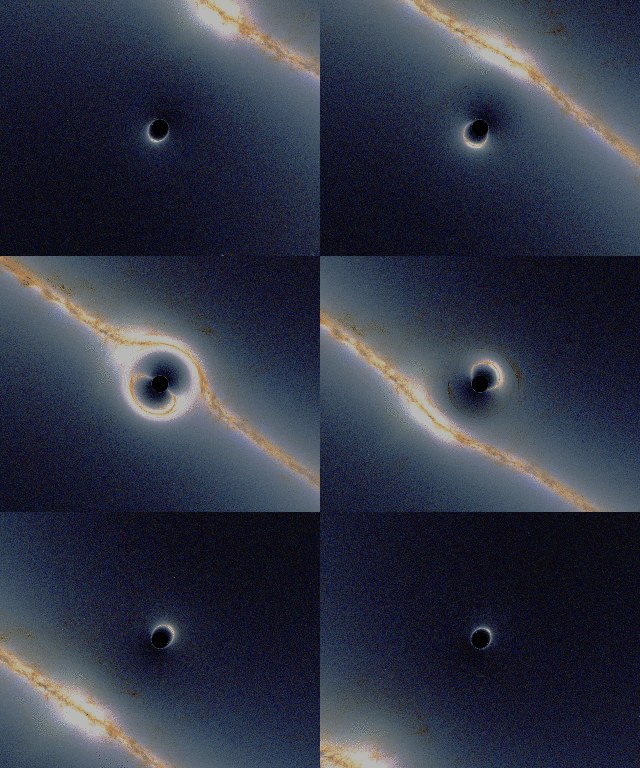
 
A simulation of gravitational lensing around a black hole and a galaxy

Many of the properties of black holes are well documented, yet the formation and growth of supermassive black holes are on the cutting edge of astrophysics. Black holes usually form out of supernovas – the explosions at the end of a star’s lifespan. In young or middle-aged stars, the energy created by nuclear fusion counteracts gravity, and keeps a star from collapsing into a black hole. When a massive star reaches the end of its lifespan (when it has burned all the fuel inside of it), it explodes in a phenomenon known as a supernova. Because fusion cannot occur in the remnants of a supernova, when there is not enough energy for the supernova to counteract gravity, there is nothing to prevent the remaining matter from collapsing into a dense object, such as a black hole. By astronomical standards, only supermassive stars have enough matter to become black holes, so small stars, including our sun, merely compact into white dwarfs or neutron stars. (Spoiler alert: the sun will eventually become a white dwarf, so there is no danger of it becoming a black hole.) Scientists know more about the creation of stellar-mass black holes than about the creation of supermassive black holes, but there is a possibility that stellar-mass black holes can grow to a supermassive size by rapidly consuming the matter around them.

Once a black hole forms, it can continue to grow by absorbing more and more matter. The following is theoretical. For example, in binary star systems containing two large stars, the first star to become a black hole will absorb matter from its companion star until the younger star vanishes. When black holes are too far from stars to absorb their matter, they consume the dust and gas floating around them. When two black holes collide, it has been hypothesized that they merge together to become an even larger black hole, producing a whopping amount of energy and sending ripples known as gravitational waves through the universe. 
 A stellar-mass black hole in a binary star system

So far, the only observations of gravitational waves have been contradicted by other, more detailed observations. However, as pairs of supermassive black holes at the centers of distant galaxies spiral closer and closer to each other, the chances are good that we will eventually be able to observe and study such dramatic black hole growth.

In the upcoming Marin Science Seminar, “Snacking, Gorging, and Cannibalizing: The Feeding Habits of Black Holes,” astrophysicist Steve Croft, Ph.D. will discuss how innovative telescope technologies make it possible to observe the growth of black holes in a new way, and perhaps, track disappearances from laundry baskets, tables, and refrigerators once and for all

For more information, come to the next Marin Science Seminar at Terra Linda High School from 7:30-8:30 p.m. on March 11th, 2015.

Sources:
Image Credits:

Teaser vid for “Do We Have to Grow Old: The New Science of Aging” Marin Science Seminar

Join us Wednesday, February 25th, 2015 at Terra Linda High School in San Rafael for 

Do We Have to Grow Old? The New Science of Aging 

with Gordon Lithgow PhD of the Buck Institute for Research on Aging, Novato

Aging remains one of the most mysterious processes in science. It is also the leading cause of chronic diseases such as cancer and Alzheimer’s disease. Gordon Lithgow studies the basic science of aging at the Buck Institute in Novato. He will talk about what we know about the mechanisms of aging and what scientists are doing to slow aging and eventually eradicate the chronic diseases of late life.

Teaser video below by MSS Intern Talya Klinger, Homeschooler

Big Data and Medicine – Teaser video

Join us Wednesday, February 11th, 2015 at Terra Linda High School in San Rafael for 

Big Data and Medicine 

with Art Wallace MD PhD of UCSF & VAMSC SF

Dr. Wallace will discuss the use of big data in the scientific development of medical care.  He will describe how big data has changed epidemiology, quality improvement, and drug discovery using examples from the U.S. Veteran’s Administration.

Teaser video below by MSS Intern Ben Foehr of Terra Linda High School

Spring 2015 Marin Science Seminar schedule

Join us for our 8th year of free science learning in Marin!  Six Wednesday evenings per semester from 7:30 – 8:30 pm at Terra Linda High School, 320 Nova Albion, San Rafael, CA 94903

FEBRUARY – Big Data and Medicine
11: Big Data and Medical Innovationwith Art Wallace MD PhD of UCSF and VAMC SF

25: Do We Have to Grow Old? The New Science of Aging” with Gordon Lithgow PhD of the Buck Institute, Novato

MARCH – Astronomy & Particle Physics
11: Snacking, Gorging, and Cannibalizing: The Feeding Habits of Black Holes” with Steve Croft PhD of UC Berkeley

25: Extra dimensions, mini black holes and.. Pink Elephants?: Exciting times ahead at the Large Hadron Collider with Lauren Tompkins of Stanford University

APRIL – Ecology & Genetics
1: From Monkey Flowers to Wild Mice: A Tale of Genes, Adaptation and Extreme Environments” with Katie Ferris PhD of UC Berkeley’s Museum of Invertebrate Zoology

8: Let’s Learn About Lysosomeswith Gouri Yogalingam PhD of Biomarin

Spring 2015 Marin Science Seminar internship application period now open

Explore science & technology, meet scientists and medical professionals, gain experience for your resume and college applications, develop a portfolio! Our past interns are now studying at CalTech, UC Berkeley, UC Davis, UC Santa Cruz, Cal Poly SLO, Sonoma State, and CSU Chico. Check out our blog and Vimeo page for examples of past intern blogging and videography. More info. on our internship website.

Apply Online Today or email marinscienceseminar@gmail.com if you are interested in applying. Below is a comparison of the internships currently being offered. Deadline to apply is Friday, January 16th at 5 pm.

Marin Science Seminar Writing Marin Science Seminar Photography &/or Videography
Attend and assist at MSS sessions, 6 Wednesday evenings per semester, 7 – 9pm Attend and assist at MSS sessions, 6 Wednesday evenings per semester, 7 – 9pm
At Terra Linda High School, San Rafael, Room 207 At Terra Linda High School, San Rafael, Room 207
Submit 2 writing samples Submit 2 video samples or photography portfolio
Familiarity with basic blogging interfaces (e.g. Tumblr, Blogger, WordPress) Able to edit video using video editing software, manage Instagram & Vimeo accounts
Facebook account Facebook account
Training in blogging software provided Recording equipment and SC cards provided
JokeMSS interns attend and assist with a minimum of 6 science seminars per academic year (there are 12 per year) during which they meet the speakers and assist with various logistical duties. Sessions take place on Wednesday evenings at Terra Linda High School, Room 207, during the school year. Interns arrive evening of a session at 7 pm and are free to leave once breakdown is completed (between 8:30 and 9 pm). 
Interns also assist in researching and creating materials about event topics, creating and distributing outreach materials, social networking and online development of Marin Science Seminar’s mission to attract more students to the fields of science, technology and math. Other than attending MSS sessions, duties will depend on student interests and background. Training is provided for some intern tasks.

NuSTAR: Bringing the High Energy Universe into Focus

by MSS Intern Isobel Wright, Tamalpais HS
NASA’s NuSTAR, the Nuclear Spectroscopic Telescope Array, is the first device to use orbiting telescopes to target light with high energy X-rays. The high-energy X-rays can perceive objects with 100 times more sensitivity than other missions can, which results in 10 times better resolution. This allows it to explore the hottest and densest structures in the Universe.  NuSTAR was launched on June 13th, 2012. 

 During its first two-year mission, NuSTAR will outline certain areas of the sky to take a survey of collapsed stars and black holes by studying the sectors around the center of the Milky Way, and to map new materials in infant supernovae remnants so as to interpret how stars explode and how the elements are formed. Finally, it will explore particles from galaxies which contain extremely large black holes in order to understand “what powers relativistic jets”. The NuSTAR instrument is created from two aligned grazing telescopes with specialized optics and advanced detectors that have a more developed sensitivity to higher energy forces.

February 19th, 2014 – The first map of radioactivity in the remnant of a supernova.
The blue represents the high energy X-rays observed by NuSTAR. 
Black holes are some of the most unique objects in the universe. NuSTAR studies the X-ray light that is produced by the black hole as it gathers matter. NuSTAR has various programs observing both black holes in our own galaxy as well as supermassive black holes in remote galaxies. NuStar studies the supernovae explosions which create elements that make up our Earth. With the help of NuSTAR, we can better understand how these actions occur. 

NuSTAR also studies neutron stars, which are dense remnants of supernovae. It has several programs which analyze the physical make-up and creation of neutron stars. 

Finally, NuSTAR examines relativistic jets of radiation and fragments that move around the speed of light, making them some of the most intense sources of X-ray energy in the universe. 

This is an artist’s interpretation of NuSTAR in orbit

Join us Wednesday, November 12th 2014, to hear Dr. Lynn Cominsky of Sonoma State University discuss NuSTAR and other NASA projects currently being undertaken in SSU’s Astronomy and Physics Department. Join us and learn!

California Droughts

by Isobel Wright, MSS Intern
Tamalpais High School

Having suffered three consecutive years with abnormally low rainfall averages, California faces its most severe drought in decades. In 2013, we received less rain than any year since California became a state in 1850. In fact, many Bay Area scientists have proven from tree-ring data, that on the current path, the upcoming rainfall season will be the driest since 1580. The effects of low water levels have left communities fighting over emergency water supplies, fires raging across the state, and whole species and industries are subsequently threatened.

Many reservoirs are only 30 percent full (like Folsom Lake, shown above). Retrieved from Huffington Post.

But we have had little rainfall before, so what makes this drought different? What makes this drought particularly cruel is the record-keeping heat experienced in the first half of 2014. This heat exacerbated an already devastating drought. The National Climatic Data Center released information revealing that California had its warmest January-June season since the recording began in 1895, with the temperature being 4.6 degrees Fahrenheit above average.

This graph shows the extremely low rain fall levels in 2014. Retrieved from Independent.com. 

It is thought that this intense heat is being caused by human created global warming and a persistent high pressure ridge above the West and the eastern Pacific Ocean. This ridge has prevented storms from reaching this region.

Information sources:

http://www.mercurynews.com/science/ci_24993601/california-drought-past-dry-periods-have-lasted-more
http://www.usatoday.com/story/weather/2014/09/02/california-megadrought/14446195/
http://ca.gov/drought/

Join us Wednesday, October 22nd, 2014 to learn more at Pain for Cows and Pumpkins: Drought Impacts on Central Valley Agricultural Water Supply with Douglas Charlton PhD of Charlton International.  7:30 – 8:30 pm Terra Linda High School, San Rafael, Room 207. RSVP on Facebook here.

Internship Oppotunities now Available

Marin Science Seminar offers student internships in Science Journalism (Writing) and Videography.  Computer Programming Education internships (using Scratch) are also available through Plumsite. All internship information for the 2014-2015 school year can be found at Marin Science Seminar’s Internship Page.

Deadline for application: Friday, September 12th, 2014.

Public school students may apply for the School to Career internship and Work Readiness Certificate program.  Contact your school’s College and Career Center for details.

Join us and Learn! :-}

NASA in the Silicon Valley: An Introduction to the NASA Ames Research Center

by Claire Watry, Terra Linda HS

Located in the heart of the Silicon Valley, the NASA Ames Research Center is one of ten NASA field centers across the country. The Ames Research Center has been a leader in space research and development for over 60 years. It was established in December of 1939 as part of the National Advisory Committee for Aeronautics and was absorbed into NASA in 1958. The Ames Research Center currently employees 2,500 people and contributes $1.3 billion annually to the U.S. economy. It is involved in a variety of fields and a multitude of areas of ingenuity, lists of which can be seen below.

Ames’ Key Goals are as followed:

Just out the video below for a more thorough overview of the Ames Research Center or check out the official NASA Ames Research Center YouTube channel 

The focus of the presentation will be on the Human Factors Area of Ames Ingenuity. The human factors area involves “advancing human-technology interaction for NASA missions.” The human factors research is currently conducted by over 150 researchers in more than 20 labs to improve safety, efficiency, and mission success. The rapid advancement of new technology requires humans to make competent, critical decisions in a complex, technological environment. Human factors studies the interaction between humans and engineering systems to ensure safe, effective, and cost-effective operations, maintenance, and training. Ames human factors encompasses a wide range of projects from simple visual perception and motor control to the more complex areas flight deck design and crew operational procedures. One of the featured examples involves placing human subjects in a centrifuge to simulate the vibration and enhanced g-forces experienced during launch and measured the subjects’ gaze stabilization reflexes, eye-movement reaction-time, accuracy, and precision, and hand-movement reaction-time, accuracy, and precision. Ames human factors includes research and development in the following areas:

  • Human-Machine Interaction improves NASA software through careful application of human computer interface methods.
  • Human Performance: develops new technologies, human performance models and evaluation tools to enhance human productivity and safety for both space and aviation environments.
  • Integration and Training: develops and evaluates methodologies to integrate human factors principles and improve aviation capacity, safety and training.
  • Intelligent Systems: conducts user-centered computational sciences research.
  • Aviation Systems: conducts research and development in air traffic management and high-fidelity flight simulation.                                              (From the NASA-Ames human factors website)
 A subject being prepared for an advanced controls and displays studies (left); a Human Computer Simulation Lab (right)

Join us this Wednesday, May 21 for this week’s Marin Science Seminar “This is Mission Control” with Jay Trimble of NASA-Ames in room 207 of Terra Linda High School in San Rafael.

~Claire Watry