“What Really Killed the Dinosaurs?” with Courtney Sprain of UC Berkeley’s Dept. of Earth & Planetary Science

What Really Killed the Dinosaurs? 

with Courtney Sprain of UC Berkeley’s Dept. of Earth & Planetary Science
Wednesday, November16, 2016

7:30 – 8:30 pm
Terra Linda High School, Room 207
320 Nova Albion, San Rafael, CA 93903
Last Marin Science Seminar of 2016
Ammonites, pterosaurs, plesiosaurs, and most famously, dinosaurs, are just a small percentage of the 75% of species that went extinct at the Cretaceous-Paleogene boundary. What caused this mass extinction? Was it a giant meteor impact? Massive outpourings of lava and gas? Or something else all together? Join Ph.D. student, Courtney Sprain, as she walks you through the very Berkeley-centric history of the of the mass extinction at the Cretaceous-Paleogene boundary and how current UC-Berkeley scientists are employing new techniques to further understand what really killed the dinosaurs. 

Courtney Sprain is a graduate student in the Department of Earth and Planetary Science at UC Berkeley. In addition to her work at the Berkeley Geochronology Center with Paul Renne on late Cretaceous Earth history, Courtney Sprain works on the records of late Mesoproterozoic paleogeography and paleointensity from the North American Midcontinent Rift in the UC Berkeley Paleomagnetism Lab.

Join us and Learn! 

Invention in Medicine this Wed. 10/26/16

Marin Science Seminar for Teens & Community Presents

Invention in Medicine

How Medical Devices get Invented and Go to Market

with Art Wallace MD PhD of UCSF & VAMC SF
Wednesday, October 26, 2016
7:30 – 8:30 pm
Terra Linda High School, Room 207
320 Nova Albion, San Rafael, CA 94903 

Art Wallace started out in experimental surgery and radiology studying imaging of the heart using CT

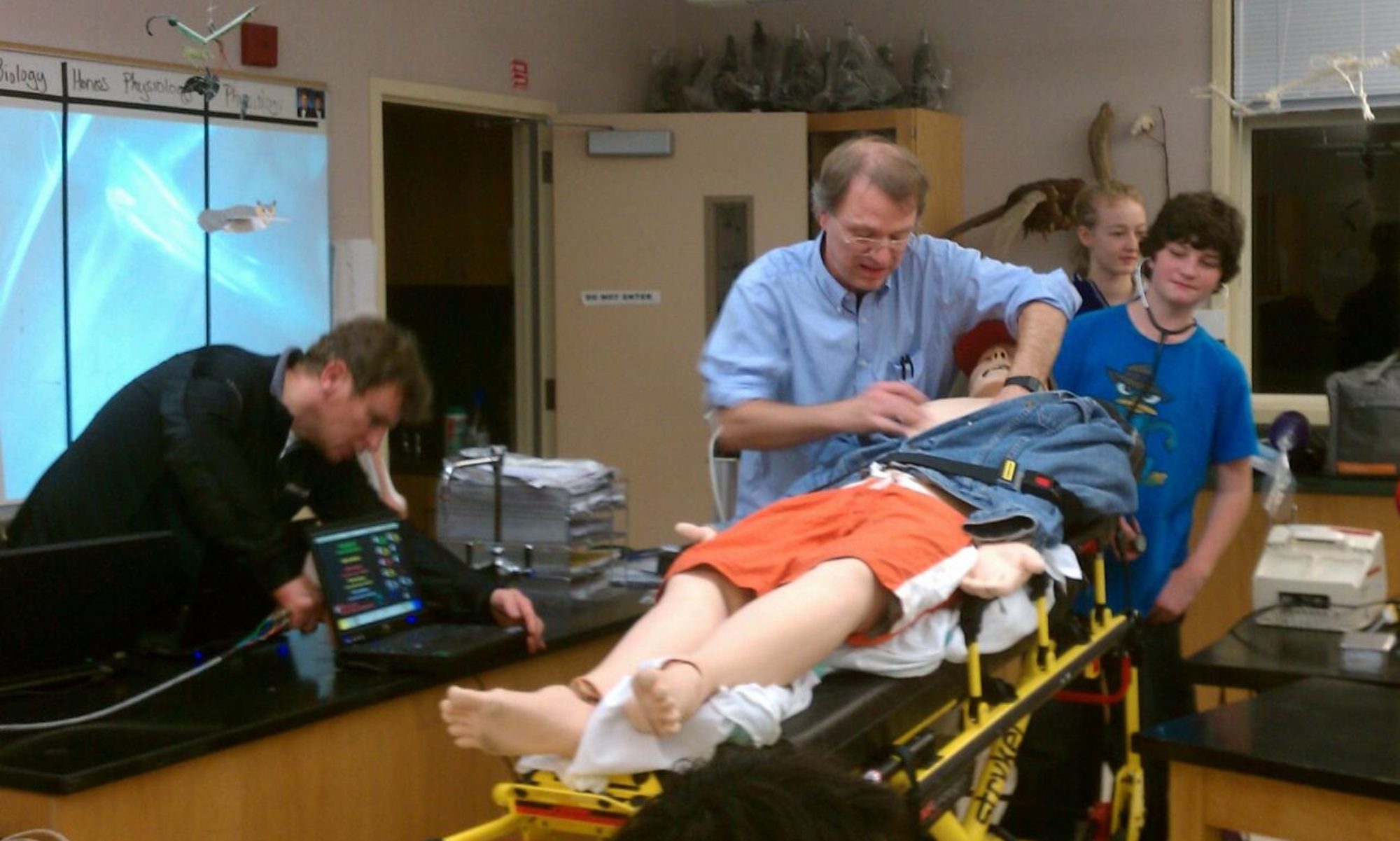
scanners. He has worked on a number of devices that originally were built for experimental studies that evolved into clinically useful devices including a cardiac output monitor, the off pump CABG, off pump aneurysm surgery, electronic sedation, and a selective coronary vasodialtor. Dr. Wallace will explain his experiences with the inventive process using examples from both device design and drug development. There will be a brief discussion of the importance of intellectual property, patents, venture capital, FDA approval, and business development in completing the invention process. There will be a demonstration of his recent developmental project on a non-contact, remote patient monitor designed to prevent cardiac arrests.

Dr. Wallace is a Professor of Anesthesiology and Perioperative Care at UCSF Medical Center, and Chief of Anesthesia Service at the San Francisco VA Medical Center. Dr. Wallace holds a B.S. in Engineering from Yale University and received his M.D. and Ph.D. from Johns Hopkins School of Medicine. His Ph.D. is in Biomedical Engineering. Dr. Wallace completed his anesthesiology residency and a fellowship in Cardiac Anesthesiology at UCSF.

Follow Marin Science Seminar on: FacebookInstagramTwitterVimeo
Join us and Learn! 

The Code of Life & the Justice System

presents
The Code of Life & the Justice System
 How DNA is used in Criminal & Humanitarian Investigations
 with Brian Harmon PhD of California Department of Justice 
Wednesday, Oct. 19, 2016
7:30 – 8:30 pm
Terra Linda High School
320 Nova Albion, San Rafael, California 94903
ROOM 207 
 Find out the truth as we take a trip into a forensic lab, and find out how analysis of crime scene DNA evidence works. We’ll discuss how a DNA profile is generated, what information it provides, and how it is used to assist criminal and humanitarian investigations. We’ll also discuss careers in Forensic Science and how interested students can prepare themselves for a career in Forensic Science. 
Brian Harmon has more than a decade of experience in forensic DNA analysis in his work for private labs, human rights projects and the government. He also provides training to forensic scientists from around the world. 
Follow Marin Science Seminar on: FacebookInstagramTwitterVimeo

Marin Science Seminar Internships Still Available

Marin Science Seminar still has two high school student internship spaces available. Interns must be able to attend science seminars on select Wednesday evenings at Terra Linda High School in San Rafael. Interns arrive at 7 pm to set up, assist with the seminar, and can leave when the seminar is cleaned up by 8:45 pm. Specialties are also available for students interested in writing, photography, videography, and social media.

Start your application online today at this link!

See the calendar here: http://www.marinscienceseminar.com/calendar.html

More information about MSS internships can be found on the website at this link:
http://www.marinscienceseminar.com/interns.html

 Join us and learn!

Myths of Astronomy Wed. 9/21 at Marin Science Seminar at Terra Linda HS

This Wednesday, September 21st  Marin Science Seminar will present “Myths of Astronomy” with Thomas Targett of Sonoma State University’s Astronomy and Physics Department. We have extra credit forms at all sessions. There will be astro-swag and door prizes for student attendees. Join us and learn!

September 21: “Myths of Astronomy” with Thomas Targett PhD of Sonoma State University
Check it out on Facebook

Much of what we think we know about space often comes from film and television, but Hollywood’s job is more often to entertain than to educate. In this presentation, Prof. Thomas Targett of Sonoma State university will sort fact from fiction, taking a tour through the worlds of Star Trek, Star Wars, and much more.

Thomas Targett obtained his undergraduate and masters degrees from Cardiff University, in Wales U.K., with a research focus on 21-cm emission from neutral hydrogen. He obtained his PhD from the University of Edinburgh, Scotland, in the fields of sub-millimeter galaxy evolution and the coupled growth of galaxies and black holes. In 2007 Dr. Targett began a research postdoc at Caltech, followed by similar appointments at the University of Birmingham (UK), the University of British Colombia, and the University of Edinburgh. He is currently an Associate Professor of Astronomy and Physics at Sonoma State University.

 Find out more here:
http://www.marinscienceseminar.com/speakers/ttargett.html 

Ocean Acidification and Exoskeletons

Marin Science Seminar for Teens and Community Presents

“Ocean Acidification and Exoskeletons”

with Diara Spain PhD of Dominican University
Wednesday, March 9, 2016 
7:30 – 8:30 pm
Terra Linda High School, San Rafael

Come learn about ocean acidification and exoskeletons with Professor Diara Spain of Dominican University. Dr. Spain is Associate Professor of Biology at Dominican University, San Rafael. She earned her B.S. in Biology Education from North Carolina Agricultural and Technical State University and her Ph.D. in Biology from the University of North Carolina at Chapel Hill. Currently, her research focuses on the functional morphology and locomotion of invertebrates.

 A teaser trailer for the presentation that will take place on March 9th, 2016 at Terra Linda High School, room 207. by MSS intern, Camden Pettijohn (Terra Linda High School)

Join us and Learn!

Internship application period for 2015-2016 now open

Marin Teens! (HS & college age) Want a cool fall internship? Check out Marin Science Seminar internships. You can apply online. http://www.marinscienceseminar.com/interns.html

Apply Online for MSS Internships
Fall 2015 Internship dates: Sept. 9 – Nov. 18
Spring 2016 Internship dates: Feb. 10 – Apr. 13

Explore science & technology, meet scientists and medical professionals, gain experience for your resume and college applications, develop a portfolio! 

JokeMSS interns attend and assist with a minimum of 6 science seminars per academic year (there are 12 per year) during which they meet the speakers and assist with various logistical duties. Sessions take place on Wednesday evenings at Terra Linda High School, Room 207, during the school year. Interns arrive evening of a session at 7 pm and are free to leave once breakdown is completed (between 8:30 and 9 pm).
Interns also assist in researching and creating materials about event topics, creating and distributing outreach materials, social networking and online development of Marin Science Seminar’s mission to attract more students to the fields of science, technology and math. Other than attending MSS sessions, duties will depend on student interests and background. Training is provided for some intern tasks.

Below is a comparison of the internships currently being offered. 

Writing or Photojournalism (Photography & Writing) Videography or Film & Photojournalism
Attend and assist at MSS sessions, 6 Wednesday evenings per semester, 7 – 9pm Attend and assist at MSS sessions, 6 Wednesday evenings per semester, 7 – 9pm
At Terra Linda High School, San Rafael, Room 207 At Terra Linda High School, San Rafael, Room 207
Submit 2 writing samples (plus photo samples for Photojournalism) Submit 2 video samples (plus photo samples for Film & Photojournalism)
Familiarity with basic blogging interfaces (e.g. Tumblr, Blogger, WordPress) Able to edit video using video editing software
Facebook and/or Instagram familiarity Facebook and/or Instagram familiarity
Training in blogging software provided Recording equipment and SC cards & reader provided
Questions?  Contact us.

All About Lysosomes

by Angel Zhou, Branson School


Lysosomes, discovered and named by Belgian biologist Christian de Duve, who eventually received the Nobel Prize in Medicine in 1974, are membrane-enclosed organelles that function as the digestive system of the cell, both degrading material taken up from outside the cell and digesting obsolete components of the cell itself. The membrane around a lysosome allows the digestive enzymes to work at the pH they require. In their simplest form, lysosomes are visualized as dense spherical vacuoles, but they can display considerable variation in size and shape as a result of differences in the materials that have been taken up for digestion. Lysosomes contain an array of enzymes capable of breaking down biological polymers, including proteins, nucleic acids, carbohydrates, and lipids.


The lysosome’s enzymes are synthesized in the rough endoplasmic reticulum. The enzymes are released from Golgi apparatus in small vesicles which ultimately fuse with acidic vesicles called endosomes, thus becoming full lysosomes. Lysosomes are interlinked with three intracellular processes, namely phagocytosis, endocytosis and autophagy. Extracellular materials such as microorganisms taken up by phagocytosis, macromolecules by endocytosis, and unwanted cell organelles are fused with lysosomes in which they are broken down to their basic molecules.
Synthesis of lysosomal enzymes is controlled by nuclear genes. Mutations in the genes for these enzymes are responsible for more than 30 different human genetic diseases, which are collectively known as lysosomal storage diseases (LSD). The group of genetically inherited disorders are a type of inborn errors of metabolism caused by malfunction of one of the enzymes. The rate of incidence is estimated to be 1 in 5,000 live births. The primary cause is deficiency of an acidic hydrolase, a hydrolase which functions best in acidic environments. The initial effect of such disorders is accumulation of specific macromolecules or monomeric compounds, affecting the brain, viscera, bone and cartilage the most drastically.

To learn more about how lysosomes can communicate with the rest of the cell to act as recycling centers of cellular waste material in good times and about how lysosomes can act as overly-filled, toxic trash cans in bad times, contributing to cell death and the onset of disease, join us this Wednesday, April 7th for this week’s Marin Science Seminar “Let’s Learn About Lysosomes with Gouri Yogalingam, Ph.D. of the BioMarin in Room 207 at Terra Linda High School in San Rafael. 


Why Matter Matters for the Large Hadron Collider

by Talya Klinger, Homeschooler

After the discovery of the Higgs Boson in 2012, the Large Hadron Collider (LHC), near Geneva, Switzerland, shut down for upgrades so that it would be able to accommodate even higher-energy collisions.

Dr. Lauren Tompkins, a physicist and assistant professor at Stanford University who worked on the ATLAS experiment at the LHC, conducts research on subatomic particles and what they can tell us about matter in general. She spoke to Marin Science Seminar on March 25, 2015 about her work.  What’s next for the LHC when it comes back online in spring, 2015?

In Dr. Tompkins’s words: 

First things first: what made you decide to become a physicist?

I became a physicist for several reasons, but the earliest motivation for me was the fact that in all of my science classes, I kept asking the annoying question: “But, why?”  If you keep asking why in biology (“why do the cells organize that way?”), then you end up with chemistry, and if you do the same with chemistry (“why do the molecules have that structure?”), you end up with physics. Particle physics, in my opinion, is the ultimate way to ask that question through experimentation.

Can you share a bit about your experiences of working on the ATLAS experiment?

I started working on the ATLAS experiment as a post-bac student in 2004, and have been loving it ever since. It’s such a massive project that I’ve been able to work on everything from software to hardware, from analysis of the simplest possible proton interactions, to simulations of what crazy new physics models would look like to us. I was lucky enough as a graduate student to be at CERN, in the experiment control room, taking detector operation shifts during the first few months of high energy collisions. That was pretty special.  

Another aspect of working on ATLAS that I love is the fact that I have over 3000 collaborators from all over the world. I get to work collaboratively with a large fraction of the scientists in my field of research. If I were doing a different type of science, I would probably be competing against them. And, although I’m a pretty competitive person, I would much rather work together on a team and build something great than try to do everything myself.

Once the Large Hadron Collider is back in operation, what’s next? 

We’ll have two main objectives. First, we need to study the newly discovered Higgs boson in much greater detail. It’s the first new fundamental particle we’ve discovered since 1994, and its properties–specifically how it interacts with other particles–will be key to understanding the larger structure of matter. Secondly, we are going to be searching for evidence of physics beyond the Standard Model of particle physics (our theory of how particles interact). For example, from astronomy and cosmology, we know that dark matter exists, but we can’t find a place for it in the Standard Model. So we are going to be looking for it at the LHC and trying to figure out how it connects to normal matter–the stuff that you and I are made of. We are also going to be looking for evidence of extra dimensions, trying to find hypothesized super-partners of the standard model particles and searching for signs that perhaps there is something smaller than quarks.  

How does your research on subatomic particles relate to matter on a larger scale? In other words, how do you answer people’s questions about why your research on matter matters? 

That is always a tough question to answer because there are so many challenges in the world right now and sometimes it’s hard to draw the line from the LHC to solving those problems. But, I do firmly believe that striving to understand the natural world is such a fundamental part of humankind that we need, and are driven, to do research like the LHC. In fact, given its scale and the sheer number of people involved, the LHC is such a beautiful example of that drive. And, of course, in trying to push the boundaries of human knowledge, we produce technologies that make their way into the public sphere as well. Personally, I anchor my work on the LHC to expanding access to science and technology careers to people who have traditionally been excluded from it. There is no reason that these explorations should be reserved for the overwhelming white and male population who have traditionally been dominant.

Do you have any advice to share with high school students who are interested in studying particle physics?

Particle physics is wonderful because there is so much of it that you can understand by reading. So, read popular science books, like those by Lisa Randall and Sean Carrol.  And watch the film Particle Fever. It does an amazing job of capturing what it’s like.  Also, take as much math as possible and don’t be afraid of it!  Math is a lot of work, but it is the language of science–you need to be fluent in it!  And, just like you aren’t born “being good” at speaking or reading, you aren’t born “being good” at math. Math takes just as much hard work as learning to speak or read; we just learn it slower because we don’t use it as much.  

Finally, do you have a favorite subatomic particle? (I’m partial to the neutrino, myself.) 

I love all my particles equally! But, if I had to choose, I guess it would be the Z boson.  We’ve learned so much about the Standard Model by studying it, and it is pretty democratic in its decays. 

http://cms.web.cern.ch/news/first-z-bosons-detected-cms-heavy-ion-collisions

Figure 1: Candidate Z boson decaying to two electrons (two tallest red towers) in a lead-lead heavy ion collision at CMS. The other red and blue towers indicate energy deposits in CMS from other particles produced.


Figure 2: Candidate Z boson decaying to two muons (two red lines) in a lead-lead heavy ion collision at CMS. The green indicates energy deposits in CMS from other particles produced.

 Image Sources:
The Magic of a New Large Hadron Collier

by Angel Zhou, Branson School

Large Hadron Collider,  Switzerland
This week, the Large Hadron Collider, or LHC, will restart after a two-year hiatus. The pause was intentional, giving technicians and engineers time to ramp up the collision energy intended to push the laws of physics to their limits. 
The LHC, completed in 2008 by the European Organization for Nuclear Research (CERN) at a cost of around $10 billion, is the world’s largest particle accelerator: an extremely long underground tunnel that allows physicists to conduct some pretty intense experiments. In essence, these experiment involve shooting beams of particles around the ring, using enormous magnets to speed them up to 99.9999 percent of the speed of light, then crashing them together. Sophisticated sensors capture all sorts of data on the particles that result from these collisions. In particle collisions, the higher the energy, the bigger the payoff, as the energy of the colliding particles gets translated into the masses of the debris, following the E=mc^2 prescription. As particles collide, their energy morphs into a shower of new particles that come flying off from the collision point.
The LHC’s biggest finding so far was the discovery of an elementary particle called the Higgs boson. Since the 1960s, the Higgs boson was thought to exist as a part of the Higgs field: an invisible field that permeates all space and exerts a drag on every particle. It had been calculated that after being formed during a collision, the Higgs boson would immediately decay into other particles in a specific ratio. Data collected after protons were crashed together showed evidence of these particles in the ratio predicted. In 2012, after three years of experiments at the LHC, physicists confirmed the Higgs boson does indeed exist. 

Higgs Boson
All the experiments conducted at the LHC so far are part of “run one.” After several years of upgrading the LHC’s magnets, which speed up and control the flow of particles, and data sensors, it’ll begin “run two”: a new series of experiments that will involve crashing particles together with nearly twice as much energy as before. These more powerful collisions will allow scientists to keep discovering new and perhaps larger particles, and also look more closely at the Higgs boson to observe how it behaves under different conditions.
To learn more about the what scientists hope to discover with the updated Large Hadron Collider, such as mini black holes, more higgs bosons, extra dimension, and perhaps, pink elephants, join us on Wednesday, March 25th for Dr. Lauren Tompkins’ seminar, “Extra dimensions, mini black holes and.. Pink Elephants?: Exciting times ahead at the Large Hadron Collider” in Room 207 at Terra Linda High School in San Rafael. For more information, visit Marin Science Seminar’s Facebook page: https://www.facebook.com/events/1426190077679597/